
Auerbach’s choral work “Dresden – Ode to peace” was commissioned by the Dresden Frauenkirche Foundation and the Sächsische Staatskapelle and premiered on February 14, 2012, in the Semperoper in Dresden, Germany. The composer has dedicated the work to the “victims of all nationalist movements around the world.”[1] An important incentive of the “Ode” was, thus, to create a musical monument to the suffering of the victims in past, present, and future. I want to argue that Auerbach has created an important contemporary work of choral music that confronts the problems posed by nationalist movements, both contemporary and historical, through a radically innovative musical language. The various subtexts of Auerbach’s aesthetic language are influenced by the tradition of the Central European Jewish Enlightenment, and it is a work that addresses contemporary issues through a modern and unique array of aesthetic means.
Introduction to the “Ode to peace”
The “Ode” represents an unusual contribution to the genre of the Requiem: with the exception of the “Kyrie”, the “Lacrimosa” and the “Libera me”, Auerbach has abstained from including the normative elements of the missa profunctis and replaced them with central prayers of the great world religions. The texts appear in Auerbach’s very own compilation and order. Most of the prayers that Auerbach has selected for the “Ode to peace” are those in which the personal relationship of the worshipper to god is in the foreground of the text, a choice to which we shall turn further below.[2] There is a centrality of the motif of the individual worshipper wishing to spiritually “climb” to the purest realms of reality in Auerbach’s work, her poetry and visual artworks in general. In the Requiem, the drive (or kavanah) of the individual worshipper to be heard by the highest entity with his prayers is being (re)-planted within the most refined traditions of the Abrahamic religions, this is to say, Auerbach takes the listener back to the origins of the (pre-exilic) Judaic traditions of odes (the psalms) as well as to the roots of non-monotheistic cultures. As such, and with this tendency to encompass vast cultural repositories, Auerbach’s “ode to peace” can be called a modern work of reformation, written for a 21st-century audience. We encounter some central psalms of the Jewish-Christian liturgy (for example, Psalms 23, 100, and 134). Auerbach is mindful that they originated in the Babylonian Exile and that the psalm literature was continued in the post-exilic tradition of mourning. There is also the “Pater noster”, the “Hear, oh Israel” (appearing along with the “Kaddish”, the Jewish prayer of mourning) and the “worship to the arch angels” from the Jewish evening prayer, the “Maariv (but influenced by the tradition of Jewish mysticism), all presented in a radically new sound shape. In addition to prayers from Judaism, Christianity and Islam (the “Fatiha”), Auerbach included central prayers from Buddhism and Hinduism.
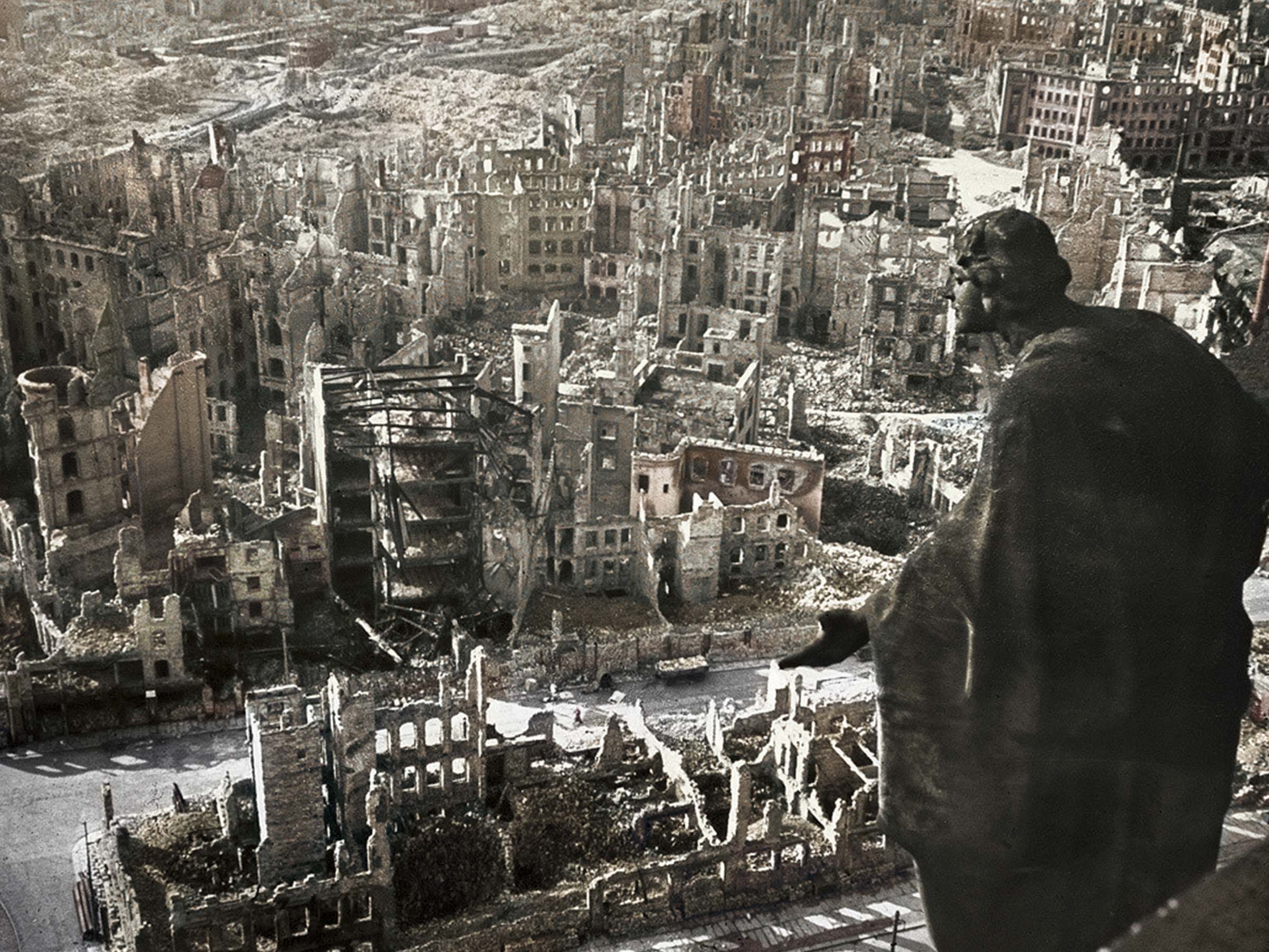
The composition and performance of a work where prayers from all world religions are featured in one single choral piece, solemnly performed in the recently renovated Frauenkirche (a symbol of destruction itself!), yet written by a Russian-American Jewish artist, may well represent a subtle counter-version to the often-heard claim of truthfully achieved diversity in our own early 21st-century societies.[3] However, mindful of the multilayered symbolism of “Dresden” as a historical place, Auerbach refuses to let the audience identify her work with any concrete historical events or culturally bound memories.[4] Instead, the composer offers a rich venue for the audience to reflect on the history of persecution, suffering, and martyrdom, and she finds innovative ways to address its complexity through her own musical language. The rich texture of Auerbach’s music and references may be shortly exemplified by one of the main motifs in the Requiem: The “Ode to peace” contains clearly discernible references to sacred music from Dresden. The so-called Dresden “Amen”, a Protestant liturgical tune from the early 1800s, appears all the way through the “Ode to peace”. It has been previously used by Felix Mendelssohn–Bartholdy in his “Reformation Symphony”. Three decades later, it also prominently appeared as a Leitmotiv in Richard Wagner’s “Parsifal”. In the Symphony, the “Amen” is embedded in an orchestral work that represents the hopeful, optimistic culture of the rising Christian and Jewish liberal middle classes in Central Europe in the mid-19th century.[5] With quite different (if not opposite) intentions, the composer Richard Wagner used the Dresden “Amen” in his late opera “Parsifal” in an attempt to signify a lasting triumph of German nationalism and political Protestantism over the menacing cultural “threat” of liberal poets and musicians. To do so effectively, the composer aligned a medieval mythos of the holy Grail with his desire to “clean” music from the “entrepreneurial abuse” of the music industry.[6] As if commenting on this musical historical trajectory, the Dresden Amen appears throughout Auerbach’s Ode: in the archaic-sounding opening and, later, in the “Amen” (no. 15) as the materialised “angel of history” who laments the catastrophes that nationalist movements have caused. The counterpoint to this historical trajectory is a restorative understanding of the Jewish Enlightenment’s reflections on the culture of Ancient Jewish temple music.
The Dresden Frauenkirche as a “Prayerhouse of reason”
The Berlin Jewish philosopher Moses Mendelssohn considered the synagogue of the future in his important work “Jerusalem or religious power and Judaism” (1783) as a “prayerhouse of reason”, a place, where, as he pointed out, neither “dissenters” nor the unbelieving pagans or atheists were to be excluded from the ceremony (the philosopher even allows sinners to be accepted into the temple).[7] Moses Mendelssohn, who was at once a Universalist and at the same time an observant Jew, projected his vision of a “Temple of Reason” onto the year 2240 (a year that, as his biographer Alexander Altman noticed, corresponded to the messianic year 6000 in the Jewish calendar.) This embrace of outsiders and dissenters by the Jewish philosopher can be immediately paired with Auerbach’s intentions: The public performance of the “Ode to Peace” in Dresden 2012 can likewise be considered as a bold stage act or the composer’s own a projection of the “prayerhouse of reason” (It is crucial to note Auerbach’s decision to include the Prayer of Father Judge in her Requiem, the priest of the New York fire fighters’ who has been quickly recognized as the official first victim of the attacks from September 11, 2001. The judge has previously confessed to having had a homosexual inclination.[8] Moreover, the fact that the “Dresden Requiem” has 18 parts (18 equals the word for life –chai – in the Hebrew alphabet – a conscious choice by the composer) gives us a clue for the essentially Utopian or restorative-synthetic dimension of Auerbach’s important choral work.
The thinkers of the Enlightenment were not naïve: they did not assume that reasonable behaviour or an encompassing tolerance could be achieved easily by the public. The contemporary composer Auerbach is as little naïve as were her predecessors. In this draft, we can only roughly outline the common premises of Auerbach and Mendelssohn. One important element is the music’s function, comparable to that of rituals in Judaism. In his “Jerusalem,” Moses Mendelssohn also outlined his understanding of the religious function of Jewish law. The ritual law (such as the halakhic prescription to touch the mezuzah on the doorpost) was described by Mendelssohn as educational or didactic tools for the observant Jew, symbolic and gestural daily actions that prompt the practitioner to reflect upon universal divine truths without forcing the believer onto them. Mendelssohn was the first modern Jew who defended the Jewish ritual laws and customs against critics from the outside as an encoded scripture in its own right, a scripture which hints at spiritual contents and truths but doesn’t visualize them (in Mendelssohn’s understanding of the revelation, this was a preventive tool against idolatry).[9] Due to the anti-visual relation between the sign and the signified, performing rituals will trigger questions or pedagogical explanations on spiritual truths and history, but no more than that. This anti-visual quality of Jewish rituals is comparable to the relation between tune and text in Auerbach’s requiem. Relatedly, Auerbach stated about her Requiem:
“Perhaps the concept here is to simply open the door to the spiritual references, and then each listener can make their own voyage inside. In these subjects, there are no answers only questions, and the question themselves are the answers.” (Lera Auerbach in an email correspondence with me on March 19, 2018)
Auerbach’s work is a guide for the contemporary listener, but there is no concrete associative direction the audience will be led to take. The music in the prayer-house of reason is therefore analogous to the function of Jewish rituals in Moses Mendelssohn’s philosophy.[10] But in what respect is this “restorative”? In another study, Mendelssohn suggested that liturgical services during the first Jewish temple period were less structured and less orderly than those that followed.[11] Mendelssohn suggested that the original, pre-exile Hebrew poetry followed a certain “natural” path of expression of the praying individual. Hebrew poetry has been more spontaneous and improvisational, and therefore has lacked a clearly discernible metrical form. This natural and disorderly quality is not only present in Auerbach’s quite personal compilation of the prayers in the “Ode to peace”. Every prayer that Auerbach has set into music also follows the rhythmical pattern of the words of the original language. Auerbach’s musical rendition follows the accentuation and word rhythms inscribed in the Hebrew original. By doing so, she is taking the listener back to the original, but by now forgotten, style of individual prayer and expression in practice in Jewish antiquity.
Second, Mendelssohn’s holistic approach, which seeks to encompass and reach out to anyone who desires entry into the prayer-house of reason, is evident in another compositional technique in the “Ode to Peace”. As Mendelssohn points out in his own work, the Ancient Hebrew psalm literature intended to move the listener so strongly that he becomes the observer of his own emotional responses. The music of the psalms, Mendelssohn points out, underlines and supports the passions reflected in the religious poetry. The music doesn’t merely illustrate the text but infixes the spiritual component in the mind and heart.”[12] The music has both the function to animate the listener and to impress him so strongly as to prompt him to reflect on the more abstract spiritual contents. When Auerbach uses the famed scale from the Dresden Amen in number no. 15 of the requiem, the upward-moving cadenza mirrors the efforts of the praying individual to “ascend” to the divine sphere with all his individual strength. The music energizes him further.
Auerbach is an artist and musician who has deeply considered the therapeutic and energetic effects of music and its ability to resonate with personal emotions. In the context of a modern spiritual work, these are energetic traces of a “musical religion” that Auerbach intentionally left in the score and which need to be further analyzed.
[1] Auerbach: Dresden Requiem (Score).
[2] It is important to note that Auerbach left out the “dies irae”, the portrayal of the divine “day of wrath” from her work.
[3] European citizens are nowadays often confronted with the idea that our civilization firmly rests on the pillars of Christianity and Judaism only. Auerbach’s Requiem reminds us to the fact that our vision of a realized cohabitation of the religious cultures is, at best, slightly flawed.
[4] The city was subjected to four atrocious bomb raids on February 13 and 15 1945. Moreover, the square around the Frauenkirche has also, since the 1990s, disturbingly become an annual gathering place for right-wing extremists on February 14. And, finally, the city of Dresden has had an important “seat” in the cultural history of the Lutheran Reformation. There are concrete references in the work to this “reformist” aspect in Dresden’s history.
[5] For Felix Mendelssohn-Bartholdy and his generation, Protestantism represented far more than simply a “confessional creed”: the culture of the Reformation, its turn to individual understanding of religious spirituality reflected a nearly Utopian belief of having achieved full emancipation among deeply secular (or spiritually fallen?) Jews: the premise of full emancipation for Jews and other religious minorities in the German-speaking lands.
[6] This history of the adaptation of the “Amen” and, indirectly, of anti-Semitism is reflected in the provisional stages of Auerbach’s Requiem. In an early stage of the work, Auerbach intended to include passages from Martin Luther’s infamous “On the Jews and their lies” (1543) in her work – a text that has been considered as a blueprint of the destruction of the European Jews in WWII.
[7] Moses Mendelssohn: Jerusalem order religiöse Macht und Judentum. In: Alexander Altmann (ed.): Gesammelte Schriften, Volume 8, pp. 21 passim.
[8] Dresden Requiem, No.6.
[9] The holy scripture is inside the mezuzah. The believer only touches the outside box, it becomes a daily mnemotechnical spiritual tool.
[10] Moses Mendelssohn’s commentary to Exodus 15 (the song at the reed sea) in Gesammelte Schriften, Volume 3.
[11] According to Mendelssohn, there is a strong dividing line between pre-exilic and the post-Babylonian exile manifestation of the Ancient Jewish religious liturgy and the temple service.
[12] Mendelssohn: Gesammelte Schriften (ed. Alexander Altmann), Volume 3, Page 191.
Leave a Reply